10

The function $f:R_+\to R_+$ is continuously differentiable and increasing. Also, $f(0)=0$ and $f(\infty)=\infty$. Continuity and differentiability of higher orders can be assumed if necessary. The proposition on hand is the following:

If for all integers $t>0$ and for all $x> 0$, $f((t+1)x)<f(tx)+f(x)$, then for all integers $m,n>0$, $f(mx)+f(nx)\geq f(mx+nx)$.

Does there exist a proof or a counter example?

Juanito
  • 2,492
  • 12
  • 25
  • Your approach of "perturbing" the function would violate the condition that $f((t+1)x) < f(tx) + f(x)$. It is an extremely uphill task, as perturbing one part of the function would require you to change most of it. – Joshua Mundinger Jun 27 '14 at 13:27

1 Answers1

2

The following is a counterexample:

We can write

$$f(x) = \int_0^xf'(\xi)d\xi$$

If we write $g(x)$ for $f'(x)$ we can restate the problem in terms of $g$: $g$ is non-negative everywhere, it cannot go to $0$ too fast (so that its integral tends to $\infty$), and

$$\int_{kx}^{(k+1)x}g(\xi)d\xi < \int_{0}^{x}g(\xi)d\xi$$

The question is if then also for all integers $m,n > 0$ we must have that

$$\int_{mx}^{(m+n)x}g(\xi)d\xi < \int_{0}^{nx}g(\xi)d\xi$$

To construct the counterexample, first consider the function $G$ that, for some small number $\delta>0$, goes linearly from $10+\delta$ to $10$ between $0$ and $1$, is $0$ up to $2$, then constantly $6$ up to $5/2$, $0$ up to $3$, $6$ up to $5$ and from there some small constant value $\varepsilon$ to ensure its integral will tend to infinity.
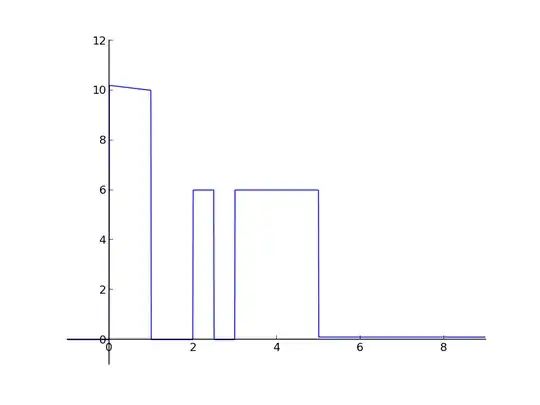
Graph of G

To ease notation, write

$$I[a,b] = \int_a^bG(\xi)d\xi$$

(so that $f(x) = I[0,x]$).

First we have to show that for all $x>0$ and all $k$

$$I[0,x] > I[kx, (k+1)x]$$

For $x \le 1$ that is obviously true, and actually up to 5/3 the average value of $G(x)$ on $[0,x]$ is more than 6, which it is on no interval starting after 1, so that for $x\le 5/3$ it is OK.

Next consider the case that $x = 2 - t$, for $0 < t < 1/3$. Then $I[0,x] = 10 + \delta/2$, $I[x,2x] < 9$, $I[2x,3x] = 6(1 + 2t) \le 10$ and for other $I[kx, (k+1)x]$ we are good.

You can treat the case $x = 2 + t$, for $0 < t < 1/2$ similarly, and for larger $x$ it is easy to see that it will work if you make $\varepsilon$ small enough (or you make $G$ zero for a while before making it a nonzero constant).

However, note that we have

$$I[0,2] < I[3,5]$$

so that

$$f(x) = \int_0^xG(\xi)d\xi$$

almost satisfies the conditions, but is a counterexample for $x = 1$, $m = 3$, $n = 2$.

I say almost, because the integral of $G$ is not continuously differentiable. We do however have enough freedom in the inequalities to smoothen $G$ to a function $g$ without violating them, and if we would want to make $f$ strictly increasing we could add a constant to $g$.

EDIT

To make the smoothing explicit you could explicitly replace the jumps by sufficiently steep slopes, but maybe the following is more elegant, and gives a $\mathcal C^\infty$-function:

Consider a sequence $(\zeta_n)$ of positive $\mathcal C^\infty$-functions with $\int_{-\infty}^\infty\zeta_n(x)dx = 1$ that converge to a Dirac mass $\delta_0$ centered at $0$ in the sense of distributions. Convolving with $\delta_0$ is the same as not doing anything, so the sequence of convolutions $g_n := G\ast\zeta_n$, which are $\mathcal C^\infty$-functions, converges to $G$. As an example you could take $\zeta_n(x) = {1\over n\sqrt{2\pi}}e^{-{x^2\over 2n^2}}$.

Essentially this means that all integrals of the $g_n$ converge to the integrals of $G$, and the required inequalities will hold for $g_n$ already, for sufficiently large $n$.

First note that $g_n$ is decreasing on $[0,1]$, so the required inequality still holds for $x\le 1$. For $x \le 5/3$ we now have to fix $\delta$ first, because $n$ will depend on it (for very small $\delta$ you may have to take a very large $n$), but we can do the same thing as before.

Likewise for the other inequalities, which are strict. Since there are essentially only finitely many of them, of integrals on subsets of a bounded set, it is clear that the required $n$ can be chosen uniformly.

Finally, let $g := g_n$ for this $n$. Then

$$f(x) = \int_0^xg(\xi)d\xi$$

is a $\mathcal C^\infty$-function satisfying all properties but not the conclusion, i.e. it is a counterexample.

doetoe
  • 4,187
  • I like your proposed answer. Could you kindly complete your answer by smoothing out the edges, and making $g$ continuous? – Juanito Jun 29 '14 at 22:02
  • Thanks for your response. Kindly bear with me, as I do not have much maths training. What do you mean by fixing a $\delta$ to get a $n$? I can understand that this is about some kind of convergence. Or at a more basic level, by $\delta$, do you mean the difference between the integrations of the original function, and the approximating functions? (This would imply $\delta$ would depend on the tightness of the inequality at that point.) – Juanito Jul 01 '14 at 02:38
  • Welcome! I was just referring to the $\delta$ used in the definition of $G$, which was just needed to make $G$ initially decreasing, so that the condition would hold for very small values of $x$ ($I[0,\epsilon] < I[k\epsilon, (k+1)\epsilon]$). I called it $\delta$ because it has to be sufficiently small (though $\delta = 1$ or $2$ would be fine) to be a counterexample, but it cannot be too small. For a fixed $n$ not all (sufficiently small) $\delta > 0$ would do anymore in general, but just fixing some $\delta$, for sufficiently large $n$ we are good. – doetoe Jul 01 '14 at 08:11
  • Feel free to ask if you want any more clarification. – doetoe Jul 01 '14 at 08:20
  • How did this question come up by the way? It's a nice one, I tried for quite a while to prove it before looking for a counterexample – doetoe Jul 01 '14 at 08:28
  • Thanks, I will write up the whole thing again, and will ask you if I have any questions. This came up as part of another question. Initially it seemed that the proposition was intuitive, but, I could not come up with a proof. After a point, I was convinced that there would be a counter-example, but, as I mentioned in the bounty comment, I was not being able to get the details right for the counter example. – Juanito Jul 01 '14 at 18:42
  • I was trying to prove that $g_n:=G\zeta_n$ are $\mathcal C^\infty$-functions. I though about starting by taking a G function which is constant at some interval, and zero everywhere else, and then computing its convolution with the gaussian distribution. I figured that definite integrals of the gaussian distribution are not analytically computable, so, that approach failed. Is there an indirect way to figure out why $g_n:=G\zeta_n$ would be $\mathcal C^\infty$-functions? – Juanito Jul 14 '14 at 20:08
  • 1
    @Juanito Sorry, I was offline for a few days. I guess the easiest is not to think of $G$ and $\zeta_n$ in explicit terms, only that $G$ is integrable and $\zeta_n$ is smooth and vanishes at infinity. Then writing out the definition of the convolution, $g_n(x) = \int G(x - t)\zeta_n(t)dt = \int G(t)\zeta_n(x - t)dt$ we see that in the second expression we can just differentiate below the integral sign to see that all derivatives exist and are continuous. – doetoe Jul 19 '14 at 09:41
  • Thanks for all the help, it was really helpful for my work. Could you tell me your actual name, so that I can acknowledge you in my work? Also, if you are not comfortable telling your name in public, we can perhaps arrange for some other way. I had to contact you on the post, as MSE does not allow chat. – – Juanito Sep 03 '14 at 01:16
  • You're more than welcome! Please mail me at my MSE username at gmail.com – doetoe Sep 03 '14 at 06:17