
I am struggling understanding this finding. Can somebody explain intuitively why randomly drawn high-dimensional vectors will tend to be mutually orthogonal? I realize that intuition in high dimensions might be too much to ask for, still, an explanation without having to integrate over several pages of symbols would be preferred.
Asked
Active
Viewed 1.9k times
48
-
4(A) what is the source for this (B) what do you know so far? – Will Jagy Oct 28 '14 at 21:07
-
18Others are using more rigour, but I think it simply as follows. By rotational symmetry of the distribution you might as well look at the inner product of a random vector and $(1,0,0,\ldots,0)$. That inner product is zero-mean, but its variance will be $1/n$. So when $n$ is in the hundreds, you need quite a few SDs off the mean to have a significant inner product (for a suitable value of "significant"). – Jyrki Lahtonen Oct 28 '14 at 22:03
-
@JyrkiLahtonen I will edit my answer to incorporate this line of reasoning explicitly. – Jonas Dahlbæk Oct 29 '14 at 08:33
-
@user161825: I had already upvoted your answer among others :-) – Jyrki Lahtonen Oct 29 '14 at 11:07
-
@JyrkiLahtonen thank you - this is very helpful. – b87lar Oct 29 '14 at 14:56
-
See also: Average angle between random points in $[-1, 1]^n$ – Martin Thoma Apr 01 '17 at 13:08
-
It helps me to think of high dim'l vectors as grayscale images with many thousands of pixels, rather than being drawn as in 2d and 3d. When we restrict to non-negative vectors, the average $\displaystyle \int (e⋅y) dS_{+}^{n}=\frac{\Gamma(n/2)}{\sqrt{\pi}\Gamma((n+1)/2)}$. When $n=2k$ is even, this reduces to $\displaystyle \frac{2^k (k-1)!}{\pi (2k−1)!!}$, and when $n=2k+1$ is odd $\displaystyle \frac{(2k−1)!!}{2^{k} k!}$. This is about .08 when n=100, and about .025 when $n=1,000$. If we take two random words, use an n=500 word2vec embedding, we expect a cosine similarity in [.025,.08]. – Jackson Walters Sep 17 '20 at 17:50
-
Note that this bit of lore only applies to unit vectors. Here are some numerical examples: https://drscotthawley.github.io/blog/2022/01/24/MultiDim-DotProducts.html – sh37211 Jan 24 '22 at 23:24
7 Answers
40
A random uniform unit vector is $X/\|X\|$ where $X$ is standard normal, thus the scalar product of two independent unit vectors $U$ and $V$ is $\langle U,V\rangle=\langle X,Y\rangle/(\|X\|\cdot\|Y\|)$ where $X$ and $Y$ are independent and standard normal. When $n\to\infty$, by the law of large numbers, $\|X\|/\sqrt{n}\to1$ almost surely and $\|Y\|/\sqrt{n}\to1$ almost surely, and by the central limit theorem, $\langle X,Y\rangle/\sqrt{n}$ converges in distribution to a standard one-dimensional normal random variable $Z$.
Thus, $\sqrt{n}\cdot\langle U,V\rangle\to Z$ in distribution, in particular, for every $\varepsilon\gt0$, $P(|\langle U,V\rangle|\geqslant\varepsilon)\to0$. In this sense, when $n\to\infty$, the probability that $U$ and $V$ are nearly orthogonal goes to $1$.
Likewise, $k$ independent uniform unit vectors are nearly orthogonal with very high probability when $n\to\infty$, for every fixed $k$.
-
Concerning your last remark, and interesting variation would be to study the maximum inner product between any two of the $k$ random iid uniform vectors, in the limit when both $k$ and $n$ go to infinity while being related in some sense, say $n^{\ell}\log n \ll k \lesssim n^{\ell+1-\delta}$, for a fixed integer $\ell$ and fixed $\delta > 0$. – dohmatob Apr 11 '21 at 11:23
-
What does "independent uniform unit vectors" mean? Also, not sure what "where $X$ is standard normal" means here either :/ – Noein Dec 30 '21 at 13:16
-
1Found this page after Google search on similar question. This answer is interesting but it assumes that the vectors are unit vectors, whereas OP's question made no such restriction. Turns out that, in the case where the random vectors are not unit vectors (i.e. are truly random), then they're still likely to be orthogonal, but increasingly less so as the number of dimensions increases. – sh37211 Jan 24 '22 at 23:23
-
2Does anyone know of a result showing the rate of convergence toward orthogonality as $n$ grows? e.g. I think a finite sample high probability bound is possible, like $|\langle U,V\rangle| \leqslant \mathcal{O}\left(\log\left(\frac{1}{\delta}\right) \frac{1}{n}\right)$ with probability $1 - \delta$ for any $\delta \in (0, 1)$. – kdbanman Mar 21 '23 at 16:10
-
And one might be able to make a more general result which includes a possible nonzero covariance between $U$ and $V$ – kdbanman Mar 21 '23 at 16:10
18
Here is one way to reason, chosen for simplicity of calculations: Consider the unit vector $e=(1,0,0,\ldots,0)\in\mathbb R^n$. One way to measure how 'orthogonal' $e$ is to other vectors is to calculate the average of $(e\cdot x)^2$ as $x$ ranges over the unit sphere. If $S$ denotes the surface measure on the unit sphere corresponding to (normalized) area, then $$ \int |e\cdot y|^2 dS(y) =\int |y_1|^2 dS(y)=\frac{1}{n}\int \sum_{j=1}^n |y_j|^2 dS(y)=\frac{1}{n}. $$ Thus, in this sense, vectors are generally 'more' orthogonal in higher dimensional spaces.
Edit: This line of reasoning follows closely the argument given by JyrkiLahtonen in the comments above, as one sees by considering a random $\mathbb R^n$-valued vector $Y$, uniformly distributed on the unit sphere. If we consider the random variable $e\cdot Y$, then $$ E \; e\cdot Y=\int e\cdot y \;dS(y)=0, $$ because $S$ in invariant under the transformation $y\mapsto -y$. On the other hand $$ V(e\cdot Y)=\int |e\cdot y|^2 dS(y) =\frac{1}{n}, $$ as shown above. Therefore, intuitively, $e\cdot Y$ is small when $n$ is large. Rigorously, we can employ Chebyshev's inequality to obtain $$ P(|e\cdot Y|\geq \epsilon)\leq \frac{1}{n\epsilon^2}. $$
Jonas Dahlbæk
- 5,036
-
1In the first computation, it helped me to add some steps. First, note that $\sum_{j=1}^{n}|y_j|^2 = |y|^2 = 1$ when $y \in S$, the unit sphere. In going from $\frac{1}{n}\int n |y_1|^2 dS(y)$ to $\frac{1}{n} \int \sum_{j=1}^{n}|y_{j}|^2 dS(y)$ we might note that we are splitting up the integral and applying dS-invatiant permutations $1\rightarrow j$ for all $j$. V is measuring the variance, and this being small means the average (expectation value) of $e \cdot y$ should be close to 0. We could also apply a dS-invariant rotation matrix to $e$ to show invariance of choice of reference vector. – Jackson Walters Sep 16 '20 at 22:09
-
7
In statistics orthogonality is deeply linked to correlation. Random vectors are orthogonal when the values they contain are uncorrelated, meaning that in the $x_i$ values of $\vec{v_1}$ and $\vec{v_2}$ do not appear common patterns. The higher the dimension is the higher is $i$ and so the probability is higher that $x_{i}$ value of $\vec{v_1}$ and the $x_i$ values of $\vec{v_2}$ have no common pattern, because the higher the dimension the higher the possibilities (in an urn problem increase the number of balls ...). Equivalent to the statement that $\vec{v_1}$ and $\vec{v_2}$ have no common patterns is the statement that they are uncorrelated what is equivalent to the statement that they are orthogonal.
So the key to understand why randomly drawn vectors are perpendicular in high dimensions is the deep link between orthogonality and statistical correlation :
This is linked to a more philosophical question if real randomness actually exists. There are strong hints that this is not the case, i.e. nonlinear dynamical systems (chaotic systems) are able to generate white noise in a deterministic way : https://ieeexplore.ieee.org/document/1236865 - Chaotic maps generating white noise
ralf htp
- 171
5
Here's an excerpt from Lecture 2 of Keith Ball's An Elementary Introduction to Modern Convex Geometry:
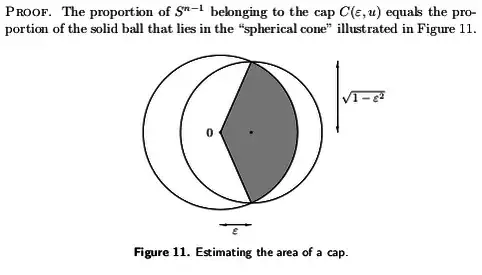
See the link for details, but as the image shows, the measure of a spherical cap cut off by a hyperplane which is $\varepsilon$ away from the origin is bounded above by the ratio between volume of a ball of radius $\sqrt{1-\varepsilon^2}$ and the volume of a ball of radius 1, that is, $(1-\varepsilon^2)^{n/2}$. So if $X$ and $Y$ are independent random unit vectors (uniform on the sphere), then the portion of the cap area is $$ P(\langle X,Y\rangle > \varepsilon) \le (1-\varepsilon^2)^{n/2} \le e^{-n\varepsilon^2/2} $$ which is close to $1$ when $n$ is large (if $\varepsilon$ is fixed, at least).
Wey Shi
- 105
3
For intuition let us reframe asking why some vector is orthogonal to most others as, why is some random vector almost orthogonal to most standard basis vectors?
Now the unit vector which is in some sense least orthogonal to every basis vector is
$$\tfrac1{\sqrt{d}}(1, \dots, 1).$$
Notice how we have to make this vector more orthogonal in some basis $e_i$ if we want to make it less orthogonal for some other basis $e_j$. Therefore the total "orthogonalness" stays the same. So if we do not concentrate our values in some dimensions, all of them will decrease at rate roughly $\frac1{\sqrt{d}}$ with the dimension. And this is the result proven by the accepted answer
Felix Benning
- 3,187
2
Other answers provide reasoning, but the question was asking for intuition. So here's some intuition.
In $n$ dimensional real space a set of basis vectors contains $n$ mutually orthogonal vectors. So for any vector $x$ in the space (with $||x|| > 0$), there must be $n-1$ mutually orthogonal vectors orthogonal to $x$. As $n$ increases, the probability that another vector $y$ will point more in the direction of $x$ than in the direction of one of those other basis vectors decreases as $p = 1/n$; and even if $y$ is most similar in direction to $x$, every other basis vector toward which $y$ points even nearly as much as it points toward $x$ means $y$ is closer to orthogonal to $x$. So to really not look orthogonal to $x$, $y$ is constrained to point pretty strongly in the direction of $x$, and pretty strongly not in the direction of $n-1$ other mutually orthogonal vectors. These are a pretty strong set of constraints; they aren't satisfied at random very often.
Max Robinson
- 31
- 2
1
Two vectors x and y are orthogonal if their Pearson product moment correlation is zero, so this question can be restated as: \
What is the variance of the correlation of two random $n$-vectors as a function of $n$?
For many (but not all) iid marginal distributions and $n \ge 3$, the distribution of a correlation coefficient between random vectors follows the distribution $$\rho \sim 2 \operatorname{Beta}(n/2 - 1,n/2 - 1) - 1.$$ The variance of $\operatorname{Beta}(\nu,\omega)$ is
\begin{align} Var(\operatorname{Beta}(\nu,\omega)) &= {{\nu \omega} \over {(v+w)^2 (v+w+1)}} \\ Var(\operatorname{Beta}(n/2-1,n/2-1)) &= {{(n/2-1)^2} \over {(n-2)^2 (n-1)}} \\ &= {{(n-2)^2} \over {4 (n-2)^2 (n-1)}} \\ &= {1 \over {4 (n-1)}}, \\ \end{align}
so the answer to the reformulated question is
\begin{align} Var(\rho) &= Var(2 \operatorname{Beta}(n/2-1,n/2-1) - 1) \\ &= {2 \over {4 (n-1)}}\\ &= {1 \over {2 (n - 1)}}. \\ \end{align}
Max Robinson
- 31
- 2
-
1Would this all mean that in light waves electric and magnetic field vectors could be perpendicular because higher dimensions force them to be like this? – Aug 28 '25 at 21:37
-
1To see that the first claim is true, you can use simulations (as I have), or you can follow this informal argument:
The definition of the sample correlation coefficient can be written as \begin{align} \rho(X,Y) &= {1 \over (n-1)} \sum_{i=1}^{n}{{{x_i-\overline{x}} \over {s_x}}{{y_i-\overline{y}} \over {s_y}}} \ &= \sum_{i=1}^{n}{ w_i}, \end{align} where $w_i = {1 \over {n-1}} {{x_i-\overline{x}} \over {s_x}}{{y_i-\overline{y}} \over {s_y}}$. Separating by the sign of $w_i$, \begin{align} \rho(X,Y) &= \sum_{w_i > 0}{ |w_i| (1)} + \sum_{w_i < 0}{|w_i|(-1)}.\ \end{align}
– Max Robinson Aug 28 '25 at 21:51 -
1Thus, the correlation coefficient amounts to a weighted vote of two alternatives, correlation ($1$) and anticorrelation ($-1$), determined by the sign of $w_i$, which is the sign of the slope ${{(y_i-\overline{y})} / s_y} \over {{(x_i-\overline{x})} / s_x}$. This weighted sum, if it were unweighted, would be the mean of a Binomial random variable, which is known to have a Beta distribution as its sampling distribution. The particular parameters of the Beta distribution are easily found. – Max Robinson Aug 28 '25 at 21:58
-
1@DaveTheWave, I don't think so, this is only a tendency of random vectors, not a rule about perfectly orthogonal vectors. I am not aware that the electromagnetic waves have a varying angle that is approximately orthogonal. I think that is much more likely to have to do with the orthogonality of the axes in the Complex number field. – Max Robinson Aug 28 '25 at 22:02
-
1The weighted/unweighted issue in the argument above is unimportant. The sampling distribution of the mean of the Binomial random variable is a Beta with integer parameters, the weighted version just produces parameters that are not necessarily integers. – Max Robinson Aug 28 '25 at 22:05