1

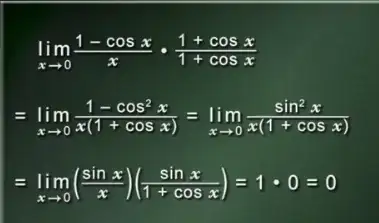
I have some difficulties understanding the last step of the screenshot.

The first step is to multiple the conjugate of the numerator. The second step is to use $1 - \cos^2(x)$ to get $\sin^2(x)$.

How and why did the author splits the $\dfrac{\sin^2x}{x(1+\cos x)}$ into a limit with two functions in it.

Can anyone help to explain the intentions and how it is derived?
Ѕᴀᴀᴅ
  • 35,400
ilovetolearn
  • 1,663

2 Answers2

2

It is known that $\lim_{x \to 0} \frac{\sin x}{x}=1$ and taking that term out make things clearer as now when we substitue $0$ into the denominator, we no longer get $0$ but the numerator still give us $0$.

Since $\lim_{x \to 0} \frac{\sin x}{1+\cos x}=0$, the overall limit is $0$.

Siong Thye Goh
  • 155,038
1

Adding to Siong Thye Goh's answer:

Remember that "the limit of a product is the product of the limits", when each individual factor's limit exists, so that

$$ \lim_{x \to 0} \frac{\sin(x)}{x} \frac{\sin(x)}{1+\cos(x)}$$

$$ = \lim_{x \to 0} \frac{\sin(x)}{x} \lim_{x \to 0} \frac{\sin(x)}{1+\cos(x)}$$

$$ = 1 \times 0 = 0.$$

The key point here is understanding why $\frac{\sin(x)}{x}$ tends to 1, as $x$ tends to 0, and then applying this limit; there are some great geometric proofs of this, if you just do a search here on this site. (Note: I don't recommend that you verify this limit with l'hospital's rule, since it's very much circular reasoning.)

  • can I treat it as a algebraic equation (split the function in the 3rd limit into two function) where sin(x) is a^2 and x is c, 1+cos(x) is d. i.e. a^2/cd and splits it into a/c * a/d? – ilovetolearn Mar 11 '18 at 12:51