5

I've worked my way through the geometric squeeze theorem proof of $\lim\limits_{x\to 0}\frac{\sin{x}}{x} $.

I was wondering how the same could be done for:

$$\lim\limits_{x\to 0}\frac{1 - \cos{x}}{x} $$

I know that we could just solve using the previous limit via multiplying by $1 + \cos(x)$ and substituting. But I'd like to be able to prove this limit with geometric intuition like we did the first.

I'm unclear how to geometrically see the initial inequality for this one. E.g. this proof begins with the geometric intuition:

$$\cos{x}<\frac{\sin{x}}{x}<1$$

and proceeds from there. Can someone explain what I should look at geometrically on the unit circle to get this or other appropriate inequality intuitions for use in the squeeze theorem? A picture of a triangle would be great, but words work just as well if you can explain the geometric intuition that sets us on our way to the squeeze theorem.

Silverfish
  • 1,949
Ben G
  • 1,013
  • 1
  • 8
  • 18
  • 1
    $\cos(\alpha)$ is the $x$ coordinate of a point on the unit circle such that the vector from the origin to this point forms an angle of $\alpha$ with the positive $x$ axis (positive angle means a counterclockwise rotation). So $1-\cos(\alpha)$ is just the complement. Draw a circle, pick a point on it, draw the projection of the point on the $x$ axis. The complement is $1-\cos(\alpha)$, i.e. the distance from the projection of this point on the $x$ axis to the point $(1,0)$. The fraction $\frac{1-\cos(\alpha)}{\alpha}$ then measures the ratio of this small distance to the angle (arc) itself. – Snaw Dec 11 '21 at 22:17
  • "draw the projection of the point" can you explain this. also which inequalities are you using here for the squeeze proof? – Ben G Dec 11 '21 at 22:53
  • I didn't comment on how to give a geometric proof, I only mentioned what the geometric meaning of $1-\cos(x)$ is (and of $\frac{1-\cos(x)}{x}$). The projection of the point $(x,y)$ onto the $x$ axis is the point $(x,0)$. – Snaw Dec 11 '21 at 23:15
  • @bgcode $1-\cos x = 2 \sin^2 x/2$ so this is just a manipulation of the $\sin(x)/x$ limit. You could probably straitjacket it into a geometric construction if you really wanted to, but it doesn't add much. – dxiv Dec 11 '21 at 23:47
  • @dxiv Is the sin(x)/x squeeze approach for geometrically obvious than this one? I'm just wondering if we build on this one instead of that one for particular reason, and also trying to build geometric intuition and proving skills. – Ben G Dec 12 '21 at 00:25
  • 4
    @bgcode It is straightforward to prove $,1 - \cos x = 2 \sin^2 x/2,$ geometrically, then $,(1-\cos x) / x$ $= \sin x/2 \cdot \frac{\sin x/2}{x/2},$ and the limit follows. I guess you could translate that into an entirely geometric argument from end to end, but it would be hard to beat the original intuition for $,\sin{\theta} \leq \theta \leq \tan{\theta},$. – dxiv Dec 12 '21 at 03:52
  • It seems to be zero. – Moti Dec 12 '21 at 04:47
  • Further to @dvix's comment, you can go further and show $(1-\cos x)/x^2$ has limit $1/2$ by splitting it as $\frac{1}{2} \cdot \frac{\sin x/2}{x/2} \cdot \frac{\sin x/2}{x/2}$, which is even more useful, and immediately implies the limit for $(1-\cos x)/x$. The obvious extension to this question is whether there is a geometric intuition for the limit of $(1-\cos x)/x^2$ but that seems likely to be even trickier :-) – Silverfish Oct 03 '25 at 12:48
  • The power of a point with respect to the unit circle gives $(1-\cos x)(1+\cos x)=\sin x\sin x$. – Bob Dobbs Oct 03 '25 at 18:06

4 Answers4

6

Unit Circle with various geometric relationships

Since $\sin(\frac{x}{2}) = \frac{1-\cos(x)}{AB}, AB = \frac{1-\cos(x)}{\sin(\frac{x}{2})}$

Then since $AD \leq AB \leq arcAB, $ $$\sin(x) \leq \frac{1-\cos(x)}{\sin(\frac{x}{2})} \leq x$$ $$\sin(x)\sin(\frac{x}{2}) \leq 1-\cos(x) \leq x\sin(\frac{x}{2})$$ $$\frac{\sin(x)\sin(\frac{x}{2})}{x} \leq \frac{1-\cos(x)}{x} \leq \sin(\frac{x}{2})$$ And we have squeezed the desired expression between two things which go to 0.

  • I love this! It looks like exactly the kind of geometric answer the OP was hoping for! What's especially nice is that your final inequality gives an even better squeeze, $\frac{\sin(x)}{x} \le \frac{1-\cos(x)}{x \sin(x/2)} \le 1$ so $\frac{1-\cos(x)}{x \sin(x/2)} \to 1$. I wonder if there is a way to use the diagram to visualise that $\frac{\sin(x)}{x} \cdot \frac{\sin(x/2)}{x/2} \le \frac{1-\cos(x)}{x^2/2} \le \frac{\sin(x/2)}{x/2}$ and hence that $\frac{1-\cos(x)}{x^2/2} \to 1$? This is a substantially stronger and more useful result and it would be nice to have a geometric visualisation – Silverfish Oct 03 '25 at 20:59
3

We have that geometrically for $x\ge 0$

$$0\le \sin x \le x \iff 0\le \sin^2 x\le x^2\iff 0\le 1-\cos^2 x\le x^2$$

therefore

$$ 0\le\frac{1-\cos^2 x}x =(1+\cos x)\frac{1-\cos x}x \le x $$

which implies $\frac{1-\cos x}x \to 0$.

user
  • 164,137
2

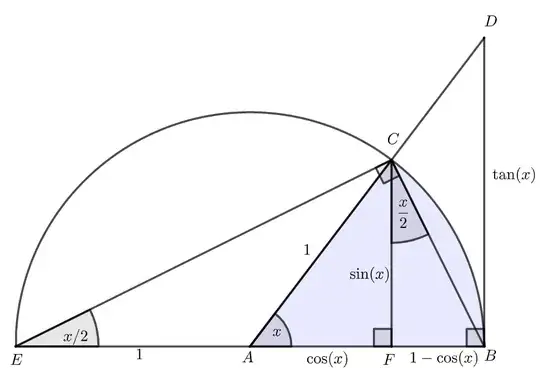
I'll borrow heavily from @robjohn's answer to the question for $\lim\limits_{x\to 0}\frac{\sin{x}}{x}$, since that seems to be the natural jumping off point for this question. But let's add some new points to his diagram: we have $\angle BCE$ as a right angle by Thales's theorem, and $\angle BEC = \frac{1}{2} \angle BAC = \frac{1}{2}x$ since the angle subtended by $BE$ at the circumference is half the angle it subtends at the centre. This also means $\angle CBE = \frac{\pi}{2} - \frac{1}{2}x$ and so $\angle BCF = \frac{1}{2}x$.
sin and tan in unit circle with tan half-angle formula

Let's follow @robjohn for a while since we'll use several of his results. The area of $\triangle ABC$ is $\frac{1}{2}\sin(x)$, the area of the larger $\triangle ABD$ is $\frac{1}{2}\tan(x)$, and the area of the blue sector is $\frac{1}{2}x$. Since the latter falls between the areas of those triangles,

$$\sin(x) \le x \le \tan(x) \tag{1}$$

Dividing by $\sin(x)$ and taking reciprocals, we deduce

$$\cos(x) \le \frac{\sin(x)}{x} \le 1 \tag{2}$$

Since $\cos(x) \to 1$ as $x \to 0$, we obtain the desired "squeeze":

$$\lim_{x\to0} \frac{\sin(x)}{x} = 1 \tag{3}$$

Dividing $(2)$ by $\cos(x)$, we get that

$$1 \le \frac{\tan(x)}{x} \le \sec(x) \tag{4}$$

Since $\sec(x) \to 1$ as $x \to 0$, we get another squeeze:

$$\lim_{x\to0}\frac{\tan(x)}{x}=1\tag{5}$$

Now I seek to extend this to find a "squeezeable" bound for $(1 - \cos(x))/x$. We know $\cos(x) \le 1$ and for acute angles $0 \le x \le \frac{\pi}{2}$ we have $\sin(x) \le x$ from $(1)$, so in this range we can bound our desired expression by

$$0 \le \frac{1 - \cos(x)}{x} \le \frac{1 - \cos(x)}{\sin(x)} = \tan \left( \frac{x}{2} \right) \tag{6}$$

Here we used the fact that this ratio appears in $\triangle BCF$. Intuitively, this triangle gets more "pointy" as the angle $x$ narrows, and so the $1 - \cos(x)$ leg goes to zero faster than the $\sin(x)$ leg does. Now since $\tan(\frac{1}{2}x) \to 0$ as $x \to 0^+$, we can squeeze:

$$\lim_{x \to 0^+} \frac{1 - \cos(x)}{x} = 0$$

Since $\tan(\frac{1}{2}x)$ and $(1 - \cos(x))/x$ are odd functions, they will also clearly approach zero as $x \to 0^-$ and so we get the desired result

$$\lim_{x \to 0} \frac{1 - \cos(x)}{x} = 0 \tag{7}$$

A much more useful result is that

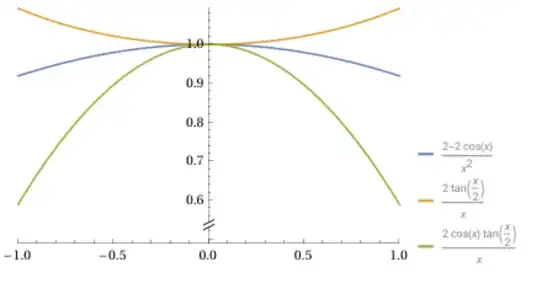
$$\lim_{x \to 0} \frac{1 - \cos(x)}{x^2} = \frac{1}{2} $$

This extends our linear approximation from $(7)$ for small angles, that $\cos(x) = 1 + O(x^2)$, to the quadratic approximation $\cos(x) = 1 - x^2/2 + O(x^3)$. By a similar argument to $(6)$,

$$\frac{1 - \cos(x)}{x^2/2} \le \frac{1 - \cos(x)}{\sin(x) \cdot x/2} = \frac{\tan(x/2)}{x/2} \tag{8}$$

From $(5)$, the limit of the right-hand side as $x \to 0$ is $1$. This is only half the squeeze; we also need a suitable lower bound. We can use the bound $x \le \tan(x)$ from $(1)$ to give

$$\frac{1 - \cos(x)}{x^2/2} \ge \frac{1 - \cos(x)}{\tan(x) \cdot x/2} = \cos(x) \cdot \frac{1 - \cos(x)}{\sin(x) \cdot x/2} = \cos(x) \cdot \frac{\tan(x/2)}{x/2} \tag{9}$$

Using $(5)$ and the fact $\cos(x) \to 1$ as $x \to 0$, this right-hand side also goes to $1$ as $x \to 0$ (limit of a product is product of the limits). So by $(8)$ and $(9)$ we now have both sides of the squeeze and obtain the desired

$$\lim_{x \to 0} \frac{1 - \cos(x)}{x^2/2} = 1 \tag{10}$$

Here's a graph showing how the squeeze looks.
graph squeeze theorem on (1-cos x)/x^2

However, I feel steps $(8)$ to $(10)$ have somewhat lost touch with the underlying geometry — although they recycle the earlier, more geometrically motivated results, they largely aren't using quantities we can visualise on the diagram. Perhaps there is a more "geometric" way to get this stronger result by comparing arc lengths or areas on the diagram in a more precise manner.


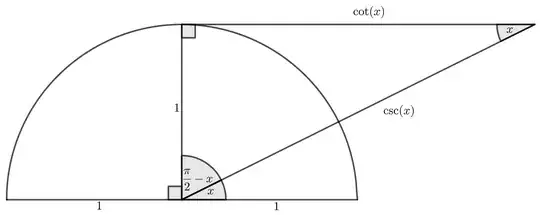
An alternative kind of geometric intuition might come from viewing $(1 - \cos(x))/\sin(x)$ as $\csc(x) - \cot(x)$. If we can show that as $x \to 0$ the difference between cosec and cot also goes to zero, that would suffice to squeeze $(1 - \cos(x))/x$ to zero.
unit circle with cot and cosec triangle

Now $\cot(x)$ is the horizontal leg of a right-angled triangle whose other leg is the vertical radius of the unit circle (so fixed at length one), and $\csc(x)$ is its hypotenuse. As $x \to 0$, this right-angled triangle gets larger, and the other acute angle becomes closer to another right angle.

In general, as you increase the size of a right-angled triangle for which one leg is fixed then the two variable sides get closer in length as your triangle becomes closer to isosceles.

A short algebraic proof: let the fixed leg be of length $1$, the other leg be $a$, and the hypotenuse $\sqrt{a^2+1}$. Then

$$\lim_{a \to \infty} \left(\sqrt{a^2+1} - a \right) = \lim_{a \to \infty} \frac{(\sqrt{a^2+1} - a)(\sqrt{a^2+1} + a)}{\sqrt{a^2+1} + a} = \lim_{a \to \infty} \frac{1}{\sqrt{a^2+1} + a} = 0.$$

But it would be nice to see this argument geometrically.

Silverfish
  • 1,949
0

Let $P(\cos x,\sin x)$ and $A(1,0)$ be the points on the unit circle. The volume of the solid of revolution of the region between the arc $PA$ and $x$-axis about the $x$-axis is $$V_2=\frac{2\pi}3-\pi\cos x+\frac\pi3\cos^3x$$ by integration. On the other hand, the volume of the cone obtained by revolving the segment $PA$ about $x$-axis is $$V_1=\frac\pi3\sin^2x-\frac\pi3\sin^2x\cos x.$$ We have $$V_1\leq V_2$$ and hence $$\frac12\sin^2x\leq1-\cos x$$ as one side of the required squeezing.

For the other side of the squeezing, consider the cylinder with radius $\sin x$ and height $1-\cos x$ whose volume is greater than $V_2$.

Bob Dobbs
  • 16,473